
News
Weser-Ems-Bus commissions mobile H2 refueling station in Germany
Following the delivery of the bus fleet and the securing of a green hydrogen supply, Weser-Ems-Bus has commissioned a mobile hydrogen refueling station in Lower Saxony, enabling the rapid deployment of its hydrogen buses while awaiting the completion of a permanent refueling station.
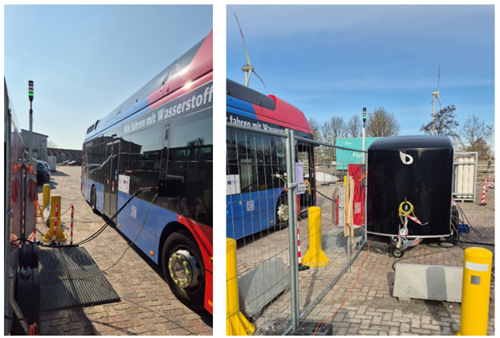
A mobile station: a practical answer to a major operational challenge. As many local authorities transition their fleets to hydrogen mobility, synchronising the deployment schedules of vehicles, refuelling infrastructure and associated equipment can prove challenging. Mobile refuelling stations provide an immediately available solution to secure the start-up phase of hydrogen mobility projects.
Partners join forces to accelerate the deployment of a hydrogen bus fleet. In December 2025, Weser-Ems-Bus, a subsidiary of DB Regio AG, deployed six fuel cell buses to provide regular public transport services from Jever in the East Frisia region of Lower Saxony. The project was developed in close collaboration with the Friesland district, the authority responsible for public transport.
Pending completion of the permanent hydrogen refueling station, Weser-Ems-Bus quickly established a partnership with the independent research institute Technologie-Transfer-Zentrum Bremerhaven (ttz Bremerhaven), station operator MoviaTec and green hydrogen producer and supplier Lhyfe.
- ttz Bremerhaven provided its own mobile refuelling station and is carrying out scientific monitoring of the buses’ deployment, allowing the institute to collect valuable operational data and insights on the performance of hydrogen buses in daily service.
- MoviaTec operates the entire refueling station at the Jever site and ensures safe and reliable operation in line with applicable safety requirements. Its role includes preparing the explosion protection documentation, coordinating regular visual inspections and operational checks, and supporting commissioning as well as the resolution of technical challenges during operation.
- Lhyfe supplies RFNBO-certified and green hydrogen, meeting the highest sustainability requirements currently defined by the European Union. With four RFNBO-certified green hydrogen production sites, a fleet of more than 80 Type IV hydrogen containers – one of the largest and most modern bulk hydrogen transport fleets in Europe – and around fifteen storage locations, Lhyfe is one of Europe’s pioneering producers and suppliers of green hydrogen.
This solution enabled Weser-Ems-Bus to immediately launch its fleet in December 2025, and to ensure a continuous supply of green hydrogen in line with its sustainability commitments.
Faster-than-expected refueling: a practical and replicable solution. The mobile refueling station operates at 350 bar, the pressure level commonly used for hydrogen-powered buses and commercial vehicles.
Before the station came on line, several refueling scenarios were modelled based on the anticipated hydrogen demand of the buses. These assumptions are now being validated under real operating conditions. Actual refueling operations have shown that buses can be refueled more quickly than anticipated in the original simulations. As a result, the station has met — and in some cases exceeded — the expectations of the project partners.
This project demonstrates that vehicle deployment and infrastructure commissioning do not necessarily need to follow the same timeline, offering a practical solution to accelerate the transition to zero-emission public transport.
The next steps will focus on further optimizing refueling operations and analyzing vehicle consumption data until the permanent station in Schortens, within the JadeWeserPark industrial area, enters service later in 2026.
From The Archives
Connect with H2Tech
