
News
Ireland's EU Presidency offers opportunity to strengthen Europe's hydrogen leadership
Ahead of Ireland's Presidency of the Council of the European Union beginning on 1 July, Irish and European representatives from government, research, industry and the energy sector gathered yesterday evening in Dublin to discuss the role of hydrogen and fuel cell technologies in strengthening Europe's competitiveness, energy security and clean energy transition.
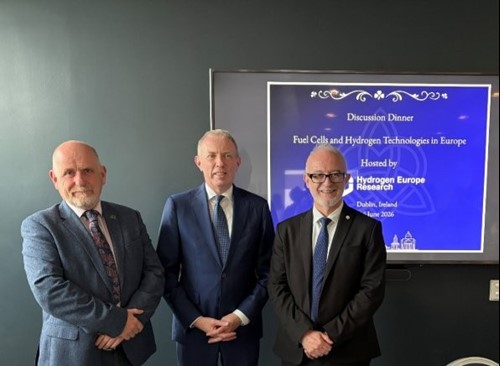
The dialogue takes place at a critical moment for Europe. As the European Union enters negotiations on its next Multiannual Financial Framework (MFF) and prepares the future Framework Programme for Research and Innovation, decisions taken over the coming months will shape Europe's ability to maintain technological leadership, industrial competitiveness and strategic autonomy in hydrogen and clean technology value chains for the next decade.
The dialogue aligns closely with Ireland's Presidency priorities on competitiveness, energy security and clean industrial development, while contributing to the broader European debate on the future of research and innovation partnerships and their role in accelerating the deployment of strategic net-zero technologies.
Minister Timmy Dooley, Ireland’s Minister of State at the Department of Climate, Energy and the Environment, said: “Ireland’s EU Presidency comes at a crucial moment for Europe’s energy transition. This dialogue provides an opportunity to strengthen exchanges between government, industry and research on how hydrogen can contribute to competitiveness, innovation and energy security in Ireland and across the EU. A key focus of Ireland’s presidency will be on the EU Multiannual Financial Framework which will help ensure adequate member-state funding for the research, development and deployment of renewable energy infrastructure required to achieve our decarbonised goals across the EU”.
Luigi Crema, President of Hydrogen Europe Research, said: “Hydrogen is much more than an energy vector. It is a test of Europe's ability to transform scientific excellence into industrial leadership. To remain globally competitive, Europe must continue investing in research and innovation while accelerating the transition from laboratory breakthroughs to industrial deployment. This will require stronger coordination across the value chain and a long-term vision that connects technology development with market creation. Future European partnerships will be essential to align research, industry and public policy around a shared competitiveness agenda”.
Paul McCormack, CEO and a founding board member of Hydrogen Ireland said: “Ireland’s hydrogen strategy is moving from ambition to implementation. Projects such as the SH2AMROCK Hydrogen Valley in Galway and the HYBERNIA cross-border valley show that clean hydrogen is no longer a future concept, it is being built on the ground today. Production and refueling hubs across Irish regions show how renewable hydrogen supports decarbonization, industrial development and energy security, and demonstrate Ireland’s capacity to produce renewable hydrogen at scale and become a net exporter. As we enter the EU Presidency, Ireland has a unique opportunity to strengthen Europe’s hydrogen leadership by accelerating the deployment of strategic projects, deepening research partnerships and supporting the development of resilient, competitive supply chains. What we need now is clear market‑making policy from government, including support for early infrastructure, planning certainty and investment signals to unlock private capital as to move from pilot projects to commercial scale”.
Brian Mullins, Hydrogen Program Director, Gas Networks Ireland said: “Gas Networks Ireland is committed to playing a leading role in the development of Ireland’s hydrogen economy, in line with the ambition of the National Hydrogen Strategy. Our vision is to deliver a net zero carbon gas network transporting only renewable gases. Green hydrogen offers a significant opportunity to harness Ireland’s renewable energy resources, strengthen both Ireland and Europe’s energy security and support the decarbonisation of industry. Realising this opportunity will require coordinated action across research, industry and government, together with investment in innovation and infrastructure. Gas Networks Ireland looks forward to continuing to work with Government and key stakeholders to help turn this ambition into reality.”
Ireland will hold the Presidency of the Council of the EU from 1 July to 31 December 2026. The dialogue take place in the context of negotiations on the next EU budget, which agreement is expected in 2026 and will shape Europe’s capacity to invest in research, innovation and strategic clean technologies over the coming decade.
Research and innovation are critical to the EU’s hydrogen leadership and industry competitiveness. Participants highlighted that Europe's hydrogen leadership cannot rely on individual projects alone. Achieving industrial scale will require stronger alignment between research organisations, industry, Member States and European institutions. A coordinated innovation ecosystem capable of supporting the entire journey from research to market deployment was identified as a key success factor for Europe's future competitiveness.
Ireland well positioned to contribute to Europe’s hydrogen ambitions. Discussions highlighted Ireland’s significant offshore wind resources and its potential to become a producer and net exporter of renewable hydrogen. Participants noted that the successful implementation of Ireland’s National Hydrogen Strategy will require continued investment in infrastructure, skills, innovation and market development.
From research to market deployment. Stakeholders stressed the need to accelerate the transition from pilot projects and demonstration activities towards commercial deployment. This includes creating clearer investment frameworks, strengthening industrial partnerships and supporting the development of strategic infrastructure required for a functioning European hydrogen market.
From The Archives
Connect with H2Tech
