
News
Hyguane: Towards low-carbon hydrogen for Europe’s Spaceport
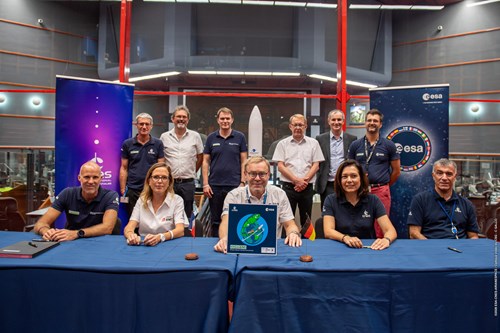
A contract for the Hyguane project was signed in the Jupiter Control Room at Europe’s Spaceport in French Guiana to construct a 4.5 MWp solar power plant called ‘PV3’. This solar power plant will be the third facility designed, commissioned, and operated by CNES, and is a key element of the Hyguane project to supply low-carbon hydrogen for Europe’s Spaceport.
Hyguane – a portmanteau of the French words for hydrogen, French Guiana and the local Iguanas – is an ambitious project led by the European Space Agency (ESA) with French space agency CNES and industrial and academic partners to develop a low-carbon hydrogen ecosystem at the Europe’s Spaceport in French Guiana.
Julia Talamoni, energy transition engineer for the Hyguane project explains, “The Hyguane project aims to produce low-carbon hydrogen to fuel Ariane 6. Currently, the hydrogen in use is produced in French Guiana from methanol steam reforming. This process produces high amounts of carbon and requires significant external heat and methanol, making the spaceport dependent on external supply.
“The Hyguane project is part of a broader initiative to reduce the carbon footprint of space activities and works towards strengthening the sovereignty and autonomy of European access to space.”
To achieve low-carbon water electrolysis of hydrogen, the electricity used needs to come from a renewable energy source. Julia continues, “The installation of the PV3 solar farm provides a low-carbon power supply to the water electrolyser, leading to the production of a ‘low-carbon molecule’.”
The Hyguane pilot scheme aims to produce up to 15% of Ariane 6 hydrogen needs a year. In addition, the Hyguane ecosystem will provide hydrogen to fuel heavy vehicles in French Guiana and to produce energy through hydrogen fuel cells, including electrical back-up of critical infrastructure systems at Europe’s Spaceport in case of a black-out.
The Hyguane ecosystem will be completed with the construction of a hydrogen refuelling station and, pending funding from ESA Member States, a garage to maintain hydrogen-powered vehicles.
Work has already begun on a water electrolysis plant and a hydrogen conditioning centre used to compress and prepare the produced hydrogen for transport, with works on the other elements of the project due to start in 2026.
Teddy Peponnet, ESA’s Head of the Hyguane project said, “The full Hyguane ecosystem will be commissioned by the second half of 2027, allowing for the first low-carbon hydrogen-fuelled Ariane 6 to fly.”
Connect with H2Tech
