
News
Jeju scales hydrogen as energy storage with KraftPowercon’s 5-MW rectifier solution
Jeju Island is becoming an important testbed for industrial-scale hydrogen production in Korea, with renewable-heavy power conditions that can challenge large electrolysis loads. In that environment, power conversion becomes critical to stabilizing the interface between the grid and the electrolyzer stacks.

In connection with an electrolyzer system being built by HyAxiom, Inc. for a hydrogen production project on Jeju Island, KraftPowercon has been selected to supply a 5 MW-class rectifier system delivering controlled DC power from the medium-voltage grid interface to the electrolysis process. The delivery is built around KraftPowercon’s H2Kraft concept, a containerized, plug-and-play power conversion solution designed to simplify installation and support efficient commissioning.
Why the power system matters more as hydrogen plants scale. Electrolyzers are DC machines in an AC world. The rectifier becomes the bridge, converting incoming AC into stable, controllable DC current for the electrolyzer stacks. As projects scale to multi-megawatt levels and multiple electrolyzer units operate in parallel, the demands on current quality increase. Stable DC delivery supports predictable stack operation, while grid-friendly behavior reduces the risk of disturbance to surrounding grid infrastructure.
Jeju adds another layer. With high renewable penetration, grid characteristics can vary, making harmonic performance and controllability central to stable hydrogen production. From HyAxiom’s perspective, system-level reliability was a primary consideration.
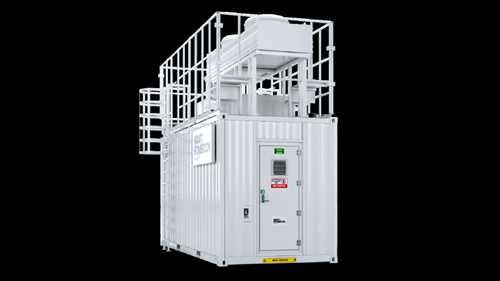
The selected approach: grid-friendly performance with practical execution. For the Jeju project, KraftPowercon will supply a rectifier system for HyAxiom’s electrolyzer system based on an active front end architecture within its I-Kraft platform, developed to reduce harmonic current contribution and support a cleaner grid footprint. A target of total harmonic distortion in current below 3 percent aligns with expectations that typically apply as plant power levels increase.
Just as important is on-site execution. H2Kraft is designed as a standardized container concept supporting a plug-and-play approach. By reducing installation complexity and enabling a straightforward electrical layout, the solution is intended to help project teams move efficiently from delivery to commissioning, with fewer site interfaces to manage.
“At this scale, we assess technical compliance, testing capability, schedule, cost and delivery,” Thomas adds. “KraftPowercon was able to meet these requirements and provide a cost-effective and reliable solution.”
Local approvals handled up front. In Korea, permitting and inspection requirements can become schedule-critical if not addressed early. KraftPowercon supported technical clarification, documentation alignment and KESCO-related inspection readiness as part of its delivery approach, aiming to reduce approval uncertainty and protect commissioning timelines.
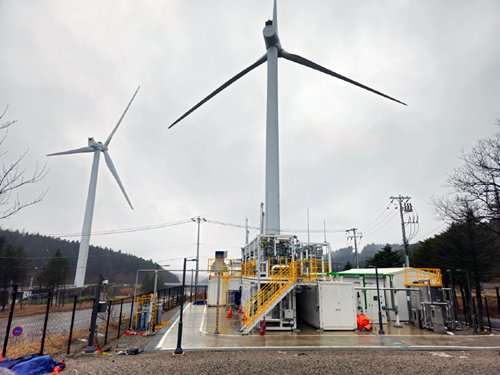
A step forward for Korea’s next hydrogen projects. As Korea moves from demonstrations toward repeatable industrial hydrogen assets, the electrical backbone of electrolysis is gaining attention. Solutions must combine grid performance with stack stability while reducing execution risk on site.
“Long-term reliability of all subsystems is essential to meet overall cost, performance and availability targets,” Thomas emphasizes.
With Jeju Island as a proving ground, the project signals a broader shift in the market. As hydrogen projects scale, the role of robust power conversion becomes increasingly central — ensuring predictable operation, compliance with local requirements, and support for industrial-scale hydrogen production.
From The Archives
Connect with H2Tech
