
Articles
The low‑carbon H2 from byproduct recovery
Hydrogen (H2) demand is expanding because it has the potential to displace fossil fuels in heavy industry, transport and power. Today, however, most of the 100 MMt of H2 produced worldwide comes from natural gas and coal and emits about 900 MMtpy of carbon dioxide (CO2). Byproduct (recovery) H2—H2 unintentionally produced during industrial operations such as catalytic reforming in refineries, steam cracking of hydrocarbons, chlor‑alkali processes and coke oven gas recovery—already supplies part of today’s market.
In 2022, the International Energy Agency (IEA) estimated that byproduct H2 constituted ~16% of global H2 production, mainly from naphtha reforming during oil refining.1 Much of this H2 is used internally for process heat or vented to the atmosphere because separation and purification are not economically attractive.1 Using byproduct H2 as a feedstock for low‑carbon H2 could therefore reduce waste, cut emissions and accelerate the H2 economy.
This article summarizes the current status and projected future of low‑carbon H2 production from byproduct streams, identifies facility types that enable recovery and discusses the engineering challenges of such projects. All information reflects public sources available as of May 31, 2025.
CURRENT STATUS OF BYPRODUCT H2
Sources and volumes. Industrial processes that unintentionally generate H2 include:
- Catalytic reforming in refineries: More than 35% of H2 used in refineries is obtained as a byproduct of naphtha catalytic reforming.1 Another IEA review notes that roughly half of refinery H2 demand is met by byproduct streams from catalytic reformers and steam crackers.2 The U.S. produced about 3.3 MMt of captive byproduct H2 in 2017.3
- Steam crackers: These units crack ethane or naphtha into ethylene and other olefins. The overhead stream from the demethanizer contains H2 and methane (CH4), and cryogenic separation at –157°C (–250.6°F) can separate H2 from CH4.4 A review of U.S. steam crackers suggests they could produce 3.5 MMtpy of byproduct H2, nearly doubling the U.S. merchant H2 market—purified H2 costs $0.90/kg–$1.1/kg and can earn low‑carbon fuel credits.5
- Chlor‑alkali plants: The electrolysis of brine to make chlorine and caustic soda yields H2 at the cathode. H2 can be burned for steam production or vented. A study of a Chinese chlor‑alkali plant showed that using a H2 boiler produced 28 t/hr of steam at 25 bar and 245°C (473°F), while an alkaline fuel cell could generate 7.65 MW of electricity using the boiler and avoided 49,300 tpy of carbon dioxide equivalent (CO₂e) for the H2 boiler.6 Lifecycle assessments indicate that chlor‑alkali byproduct H2 emits 1.3 kg CO₂e/kg–9.8 kg CO₂e /kg of H2. This is 20%–90% lower than steam CH4 reforming (SMR).5
- Coke oven gas (COG) and chemical processes: Coke ovens, methanol and ammonia synthesis, propane dehydrogenation and other processes produce H2‑rich purge gases. A Chinese white paper cited by Dialogue Earth estimated that extracting H2 from industrial waste gases costs 0.30 yuan/kg–0.60 yuan/kg ($0.04/kg–$0.08/kg), and purchasing byproduct gas adds up to 10 yuan/kg–16 yuan/kg ($1.4/kg–$2.25/kg).7
China, the world’s largest H2 producer, generates 13 MMtpy–16 MMtpy of byproduct H2, but 1.6 MMtpy–8.1 MMtpy is vented because there is neither a market nor infrastructure to utilize it.1 Vented H2 contributes to indirect greenhouse effects, increasing CH4 and ozone concentrations.1 The IEA cautions that capturing and using byproduct H2 is essential to avoid environmental harm.1
Cost and competitiveness. Byproduct H2 is inexpensive because no fuel is consumed to produce it. Chinese data indicate total production costs of $1.4/kg–$2.25/kg.7 In the U.S., purified byproduct H2 from steam crackers costs $0.9/kg–$1.1/kg, ~30% less than conventional SMR and with 15%–91% lower lifecycle emissions.5 FIG. 1 compares these costs with gray, blue and green H2. Byproduct H2 is competitive with gray H2 ($0.7/kg–$2.2/kg) and much cheaper than blue H2 ($1.5/kg–$3/kg) and green H2 ($3/kg–$7/kg). However, because byproduct H2 originates from fossil‑based processes, its carbon intensity depends on the host plant’s emissions. Only when paired with carbon capture or renewable electricity for purification does byproduct H2 become low‑carbon.
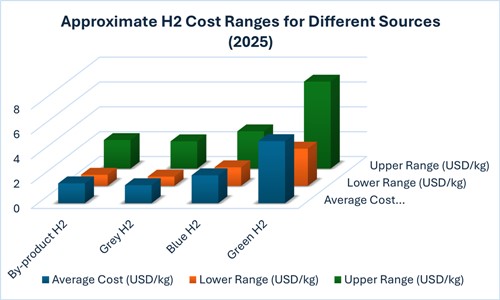
FIG. 1. Approximate cost ranges of different H2 sources (2025). Sources: byproduct H2 costs from Dialogue Earth and ideXlab; gray, blue and green H2 costs from Energy Transitions Commission and IEA (ranges converted to $). Bars show midpoints with range variation bars.
Projected future of low‑carbon H2 from byproduct streams.
Short term (2025–2030). Current decarbonization initiatives are beginning to integrate byproduct H2 with carbon capture and renewable electricity. The IEA’s Global Hydrogen Review 2024 lists projects under construction in refineries that would provide 1.6 MMtpy of low‑emissions H2 by 2030.8 Projects like bp’s HyVal and Shell’s Polaris are expected to combine onsite reformers with carbon capture and large electrolyzers for supplemental green H2. In China, local governments are building “mother stations” near steelworks or chemical plants to compress byproduct H2, and fuel buses and trucks—Shandong province’s station uses 2.6 MMtpy of byproduct H2 and can supply about 100 vehicles.7 These early projects demonstrate how localized use of byproduct H2 reduces transport costs and supports heavy‑duty vehicles.
Medium term (2030–2040). If carbon prices increase and low‑carbon H2 markets mature, capturing and upgrading byproduct H2 could become mainstream. The industrial byproduct H2 production market was valued at $50 B in 2025 and is projected to reach $85 B by 2033 [a compound annual growth rate (CAGR) of ~7%].9 Policies such as the U.S. Inflation Reduction Act (IRA) and Canada’s Clean Hydrogen Investment Tax Credit can make low‑carbon H2 competitive by providing tax credits per kilogram of qualified H2. Steam crackers and refineries are likely to install pressure swing adsorption (PSA) units and cryogenic separators to capture H2 for sale. However, the decarbonization of heavy industry may reduce byproduct production in the long term—China’s dual‑carbon targets expect a decline in coke and steel output, reducing byproduct supply.7
Long term (post‑2040). As green H2 costs decline and demand grows, byproduct H2 will remain a niche, local source. Global byproduct H2 supply is constrained by industrial output: meeting net‑zero H2 demand will require large quantities of green H2. Nonetheless, capturing byproduct H2 where it exists can provide low‑cost feedstock for local refueling clusters and chemical synthesis, particularly when combined with carbon capture or renewable electricity for purification.
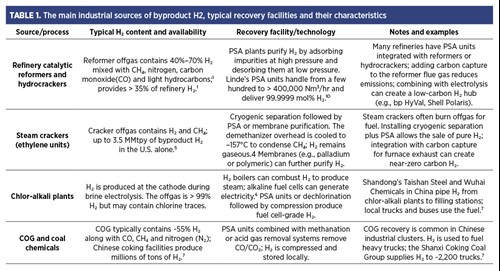
Facilities and plants enabling byproduct H2 recovery. TABLE 1 includes the main industrial sources of byproduct H2, typical recovery facilities and their characteristics.
Engineering challenges and considerations
- Separation and purification: Offgases from refineries, crackers and coking units contain a complex mix of H2, CH4, CO, CO₂, nitrogen and light hydrocarbons. Pressure swing adsorption is effective but capital‑intensive and requires multiple adsorber vessels for continuous operation.10 Cryogenic separation consumes significant energy to reach very low temperatures.4 Membrane technologies can reduce energy use but may struggle to achieve 99.999% purity.
- Integration with host processes: Byproduct H2 streams fluctuate with plant throughput, requiring flexible operation of PSA units and storage. Installing carbon capture on existing reformers or crackers involves retrofits to high‑temperature furnaces and flues. Dechlorination and drying are essential for chlor‑alkali H2.
- Compression, storage and transport: H2’s low density and small molecule size make compression and storage challenging. It must be compressed to 200 bar–700 bar for fuel cell vehicles, increasing energy use and costs. Literature notes that H2 storage requires purpose‑built vessels; small molecules can leak and cause embrittlement.11 For byproduct H2, local use is crucial: transport distances > 200 km significantly increase delivery costs, and building local filling stations is expensive (~$1.7 MM for a 500 kg/d station).7
- Safety: H2 is flammable and has a wide ignition range. Dealing with mixtures containing CO or chlorine requires careful design to avoid corrosion and toxicity. Standards and training are required for safe operation.
- Regulatory and market frameworks: Many H2 strategies classify byproduct H2 as gray, so it may not qualify for renewable fuel targets. The Hydrogen Europe Clean Hydrogen Production Pathways report notes that byproduct H2 used in industry is exempt from EU renewable fuel targets.12 The lack of low‑carbon certification can limit investment. In North America, new tax credits for clean H2 may require well‑to‑gate carbon intensity thresholds, so byproduct H2 must be paired with carbon capture or low‑carbon electricity to qualify.
- Future supply constraints: Decarbonization of steel, refining and chemicals will reduce available byproduct H2. Dialogue Earth warns that heavy reliance on byproduct H2 risks locking in fossil fuel infrastructure and that output may decline as industries decarbonize.7
Takeaways. Byproduct H2 is a significant but under‑utilized source of low‑carbon H2. It now accounts for roughly 16% of global H2 production, and about 3.3 MMt are produced in U.S. refineries.1,3 Purified byproduct H2 costs $0.9/kg–$2.25/kg, making it competitive with gray H2 and far cheaper than green H2.5,7 Recovery projects at refineries, steam crackers, chlor‑alkali plants and coking facilities demonstrate that byproduct H2 can fuel buses, trucks and industrial processes while reducing waste and emissions. Future growth will depend on integrating purification technologies (PSA, cryogenic separation, membranes) with carbon capture and renewable electricity. Nevertheless, byproduct H2 is a finite resource tied to fossil‑based industries. It should be viewed as a bridge: capturing and utilizing byproduct H2 can now reduce emissions and build infrastructure, but undoubtedly long‑term decarbonization will require expanding green H2 production.
LITERATURE CITED
1 The Oxford Institute for energy studies, “Quantifying vented by-product hydrogen: A case study in China,” November 2023, online: https://www.oxfordenergy.org/wpcms/wp-content/uploads/2023/11/Insight-140-Quantifying-vented-byproduct-hydrogen-a-case-study-in-China.pdf
2 International Energy Agency (IEA), “Global Hydrogen Review 2021,” 2021, online: https://iea.blob.core.windows.net/assets/e57fd1ee-aac7-494d-a351-f2a4024909b4/GlobalHydrogenReview2021.pdf
3 U.S. Department of Energy Office of Scientific and Technical Information (OSTI), “Life cycle greenhouse gas emissions of byproduct hydrogen from chlor-alkali plants,” December 2017, online: https://www.osti.gov/biblio/1418333
4 Wikipedia, “Steam cracking,” online: https://en.wikipedia.org/wiki/Steam_cracking
5 Lee, D. and A. Elgowainy, “Byproduct hydrogen—Explore the science and experts,” ideXlab, online: https://www.idexlab.com/openisme/topic-byproduct-hydrogen/
6 Samiee, L., F. Goodarzvand-Chegini, E. Ghasemikafrudi and K. Kashefi, “Hydrogen recovery in an industrial chlor-alkali plant using alkaline fuel cell and hydrogen boiler techniques: Techno-economic assessment and emission estimation,” Journal of Renewable Energy and Environment (JREE), Vol. 8, Iss. 1, Winter 2021, online: https://www.jree.ir/article_118477.html
7 Niu, Y., “By-product hydrogen: A bridge to a green hydrogen economy?” Dialogue Earth, October 2022, online: https://dialogue.earth/en/energy/byproduct-hydrogen-a-bridge-to-a-green-hydrogen-economy/
8 International Energy Agency (IEA), “Global Hydrogen Review 2024,” 2024, online: https://iea.blob.core.windows.net/assets/89c1e382-dc59-46ca-aa47-9f7d41531ab5/GlobalHydrogenReview2024.pdf
9 DiMarket, “Strategizing growth: Industrial byproduct hydrogen production market’s decade ahead 2025–2033,” February 2026, online: https://www.datainsightsmarket.com/reports/industrial-byproduct-hydrogen-production-114446
10 The Linde Group, “Hydrogen recovery by pressure swing adsorption,” online: https://assets.linde.com/-/media/global/engineering/engineering/home/products-and-services/process-plants/adsorption-and-membrane-plants/hydrogen-recovery-and-purification/ha_h_1_1_e_09_150dpi_nb.pdf
11 Shah, N., “The challenges of creating a hydrogen economy,” Ingenia, December 2022, online: https://www.ingenia.org.uk/articles/the-challenges-of-creating-a-hydrogen-economy/
12 Hydrogen Europe, “Clean hydrogen production pathways: Report 2024,” online: https://hydrogeneurope.eu/wp-content/uploads/2024/06/2024_H2E_CleanH2ProductionPathwaysReport.pdf
Connect with H2Tech
