
Articles
Accelerating the hydrogen timeline
Europe has led the way in the past 12 months in adopting net-zero carbon emission targets at national and EU levels. China, Japan, South Korea and others have already followed and similar targets are on the table in North America. Alongside this, we have seen a significant increase in hydrogen ambitions.
The proliferation of net-zero targets is accelerating the realisation that the energy transition must go beyond energy efficiency and rapid growth in renewables. Fossil fuels will still be needed to supply half of the world’s energy in 2050, with natural gas the world’s largest energy source, according to DNV GL’s independent model of the world’s energy system to mid-century, Energy Transition Outlook. Scaling of hydrogen and carbon capture and storage (CCS) will be needed to deeply decarbonise fossil fuels if the world is to meet the targets of the Paris Agreement.
6pc - Hydrogen share of energy demand in 2050
Governments are already translating net-zero into ambitious hydrogen strategies: some are looking to extend the life of existing natural gas infrastructure by adapting it to hydrogen, others see it as an energy carrier to complement variable renewables, while some are looking to commercial opportunities from production. What countries share is a newfound sense of urgency to realise the hydrogen economy.
Net-zero and climate targets are also putting increasing pressure on the oil and gas industry, which is focused on reducing emissions from oil and gas production in the short term while increasingly accepting that it will need to ready itself for the societal demand for an energy system that does not release carbon emissions.
Oil and gas decarbonisation
Hydrogen is rapidly becoming central to the oil and gas industry’s decarbonisation efforts. More than half of the 1,000 senior oil and gas professionals we surveyed for Outlook 2020 expect hydrogen to be a significant part of the energy mix by 2030. Further, the proportion expecting their organisation to invest in the hydrogen economy doubled from a year earlier to 42pc. Early indications from our work on Outlook 2021 show that this trend is only increasing.
However, these ambitions fall behind our latest forecasts for the world’s energy system to 2050. We see that hydrogen and CCS will be a catalyst for deep decarbonisation, removing carbon from natural gas—before or after combustion—to reach hard-to-abate sectors. But we do not expect these technologies to scale until after 2035, and to only really get going in the 2040s. Hydrogen use will scale eventually, representing about 6pc of total energy demand in 2050.
Stakeholders are pushing hard to advance this timeline, recognising that significant progress will need to be made this decade to reach the targets of the Paris Agreement.
Scaling up after 2035
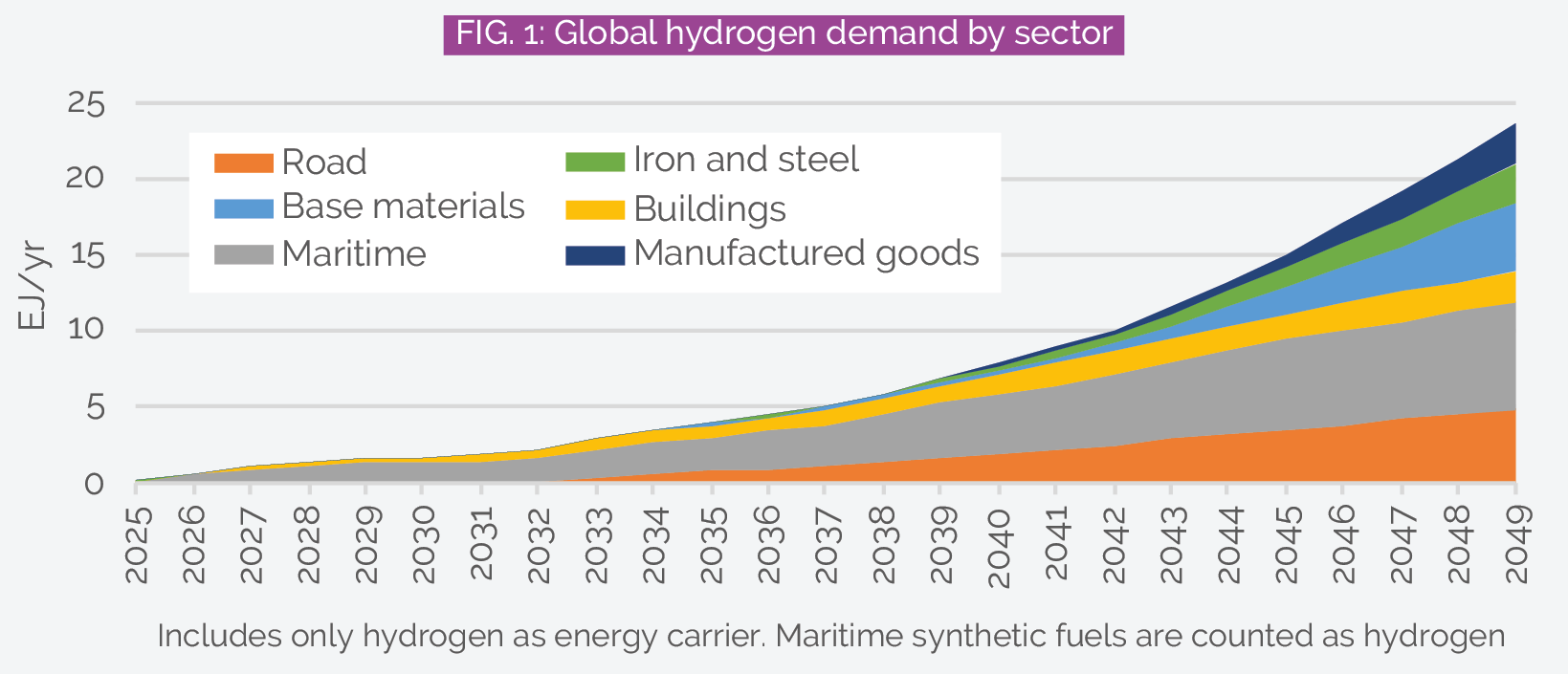
From almost no demand today, we expect demand for hydrogen as an energy carrier to emerge in the late 2020s, to then begin scaling in the mid-2030s due to demand from the transport sector—from shipping (much of it in the form of synthetic fuels produced from hydrogen) and from larger road vehicles (see Fig. 1). Moderate demand from buildings adds to this, and is then buoyed significantly by demand from manufacturing in the 2040s, with transport demand continuing to increase throughout.
Governments are already translating net-zero into ambitious hydrogen strategies
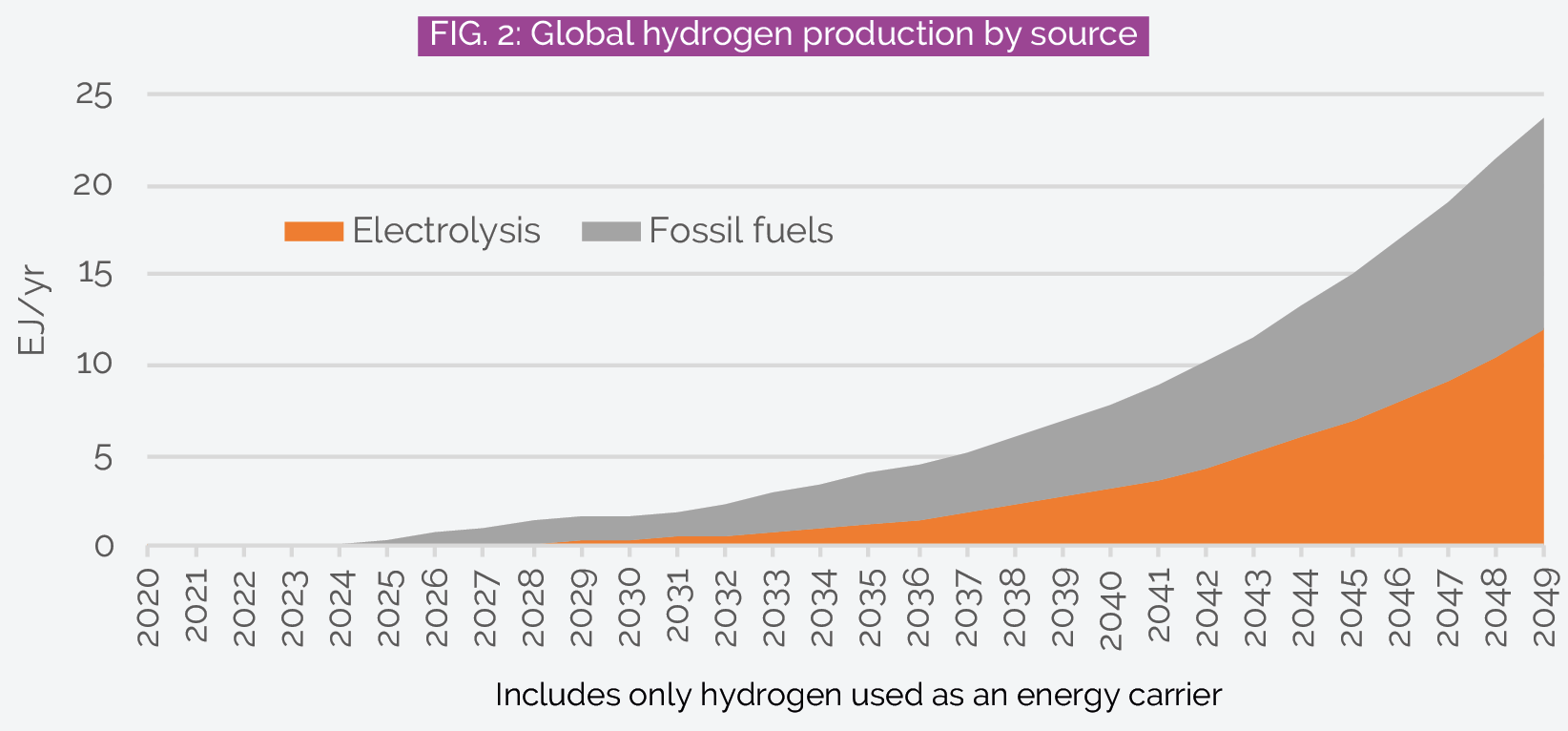
On the supply side, green hydrogen production is commonly regarded as the ultimate destination, as it does not require fossil fuels and can support electricity grid stability by providing long-term energy storage. But we forecast that blue hydrogen will be key to scaling the hydrogen economy, accounting for 85pc of hydrogen used as an energy carrier in 2030 (see Fig. 2). Green hydrogen production will ramp up from 2035 once the cost of electrolysers and renewable energy has come down and grow at a faster pace than blue hydrogen in the 2040s. The fossil/renewable source of hydrogen will be split roughly 50/50 by mid-century.
The possible lock-in of fossil fuel assets is a leading factor in the blue/green hydrogen debate. This centres on ensuring the development of blue hydrogen does not hamper the development and deployment of green hydrogen, and that it does not lead to a lock-in of carbon-intensive assets. Our research indicates that blue hydrogen, which would require a competitive carbon price and policy support, would be an enabler for the scaling of green hydrogen, as it supports the development of the necessary transportation and storage infrastructure. Nonetheless, blue hydrogen could extend the lifetime of a natural gas producing asset, where a major part of the gas is marketed and not reformed. This is a tradeoff, and its impact may depend where we are on the development timeline: blue hydrogen could accelerate the scaling of the hydrogen economy, but it could delay a shift away from non-decarbonised natural gas use.
Hydrogen is rapidly becoming central to the oil and gas industry’s decarbonisation efforts
Meanwhile, gas network operators are focusing less on the colour of the hydrogen and more on whether the energy carrier will be accepted to fuel homes and businesses. These operators, often with government support, are already working to prove the safety case for hydrogen and to adapt and develop infrastructure for hydrogen—two of the four factors DNV GL considers central to scaling the hydrogen economy. We have touched on the third factor, decarbonising production, but the fourth factor, policy, is essential to all of the above.
Policy and partnerships
Public energy policies will be key not just in setting out the path for the world and the oil and gas industry to decarbonise, but also in deciding how quickly it heads down that path. Government brings policy and incentives; industry rolls out the technology. The quicker that government incentivises industry to adopt technology, such as through a competitive carbon price, the quicker the industry takes the technology down the cost-learning curve for it to become independently financially viable. And this is true for hydrogen and CCS, just as it was true for wind and solar, which are increasing independently financially viable after years of government support.
Forming partnerships between governments and industry will be crucial. Working together to make hydrogen and CCS safe, effective and commercially viable will give the oil and gas industry and other stakeholders the certainty they need to manage new risks and accelerate the transformation towards a low-carbon future.
By Christian Parker, Content Manager, and Jorg Aarnes, Head of Low Carbon Solutions, DNV GL – Oil & Gas
Author: Christian Parker and Jorg Aarnes
Related Articles
Connect with H2Tech
